
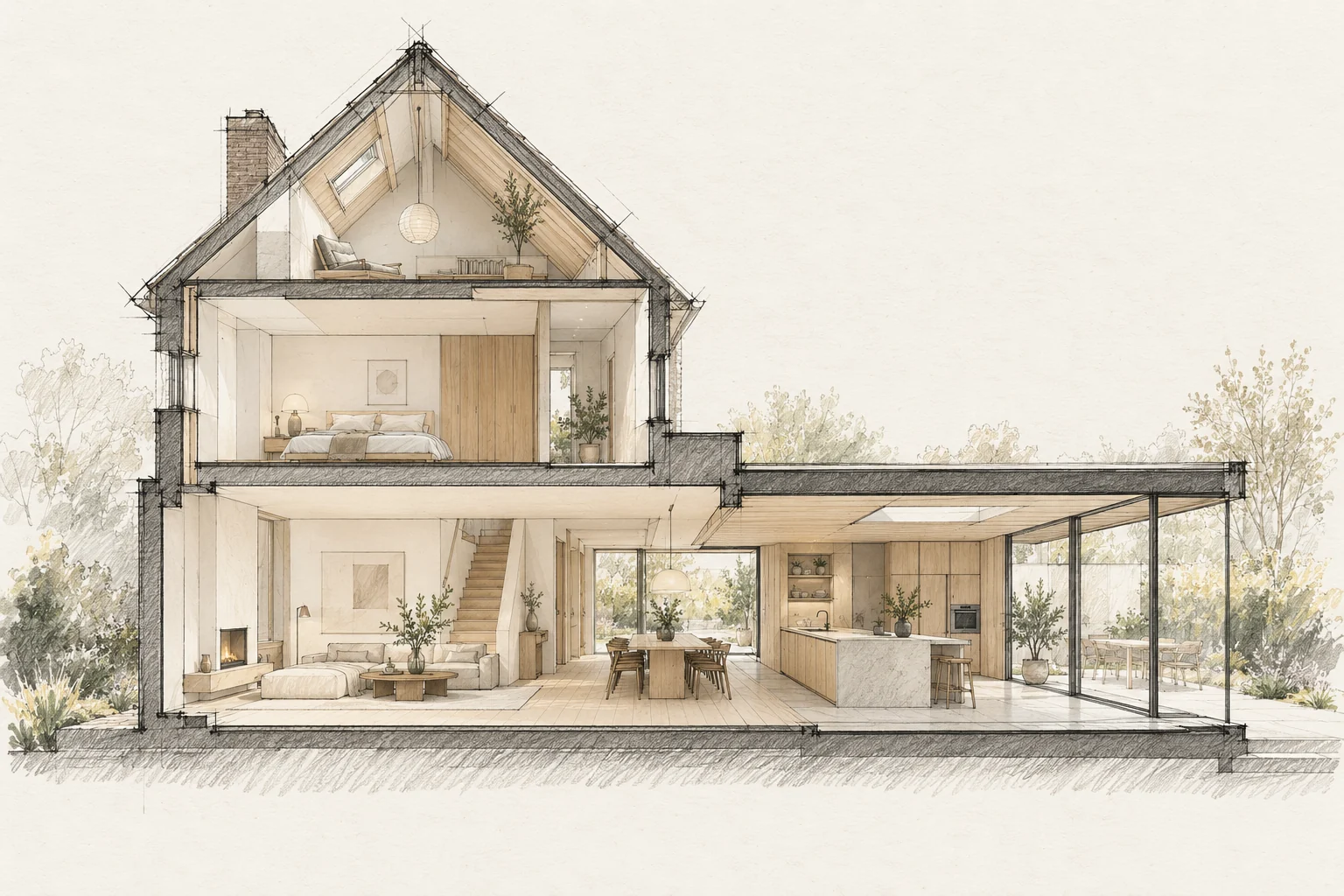
Transitions between old and new affect whether an extension feels coherent. Differences in height, material and structure should be visible early.
What the drawing needs to explain
Detail the lower edge and the junction with another material. Show where water can drain and how an element can be replaced without opening the entire finish.
Coordinate finished levels
Compare floor levels, ceilings, thresholds and the garden. Include layers still to be added, not just rough construction dimensions.
Design hidden junctions
Structure, weather protection, insulation and finishing meet at the connection. The trades should use the same detail.
How to review the result
Assess variation against the agreed sample and product information. Distinguish natural differences from damage or an incorrectly executed junction.
Which trade-off matters?
Uniform colour and low maintenance are not automatically the same choice. Compare a coated surface with a material allowed to change visibly, including access for future maintenance.
A situation to test your plan against
A house with timber and other natural surfaces gains character through use and ageing. Do not choose only from a new sample. Discuss how colour variation, touch and outdoor exposure will form part of the design.
Questions for your own property
- Are finished heights known?
- Who designs the junction?
- How are material differences handled?
Is timber weathering always a defect?
No, ageing can be part of the material choice. Agree the expected appearance and maintenance beforehand; moisture problems, damage and incorrect detailing require a different assessment.
Illustrative design situations, not evidence of completed work. Assess decisions against the actual property.